Pre-IPO Tokens: What Every Retail Investor Needs to Know
Product
 OpenAI, SpaceX, Stripe. Chances are you've watched these companies turn into generational wealth stories from the sidelines. The VC funds got in early. The private equity firms locked in returns years before any IPO. By the time most investors got a shot, the explosive phase was already over.
Pre-IPO tokens claim to change that equation. Here's what they are, how they actually work, and where the risks sit.
OpenAI, SpaceX, Stripe. Chances are you've watched these companies turn into generational wealth stories from the sidelines. The VC funds got in early. The private equity firms locked in returns years before any IPO. By the time most investors got a shot, the explosive phase was already over.
Pre-IPO tokens claim to change that equation. Here's what they are, how they actually work, and where the risks sit.
Why pre-IPO tokens matter
Private markets have structurally shifted where value is created.
In the past, IPOs were the starting line: The moment retail investors could participate in a company's growth story. Today, the best companies stay private longer. Apollo's chief economist has noted that the median time from founding to IPO in the US has stretched to 14 years (2024–2025 data). By the time a company lists, the biggest valuation jumps have already happened behind closed doors.
Pre-IPO tokens aim to change that. Using tokenization technology, they try to open a crack in the walls of the private market. Through onchain assets, SPV interests, or synthetic exposure, they offer a way for everyday investors to access the value curves of companies like OpenAI, Anthropic, and Stripe before they go public.
OpenAI and Anthropic: Where the lines are
OpenAI and Anthropic have both made public statements about unauthorised equity trading, and it's worth understanding exactly what they drew attention to:
-
OpenAI's position: Any equity transfer without the company's written consent, including through SPV or tokenised structures, is considered invalid.
-
Anthropic's position: Transfers not approved by the board will not be recorded in the shareholder register. Buyers do not obtain legal shareholder status.
The key takeaway: holding a Pre-IPO token, even one that trades actively in secondary markets, does not make you a legal shareholder of the underlying company. Shareholder status remains subject to company articles, legal documentation, and board approval.
Pre-IPO tokens vs. official equity
There are two things worth distinguishing: officially recognised company equity, and onchain economic exposure built around private market valuations.
Official equity means the holder is on the company's shareholder register, with rights – voting, dividends, information – as defined by the company's articles and applicable law. For private companies, this is tightly restricted and typically requires board approval at every step.
Most Pre-IPO tokens on the market today are not the same as company stock. More commonly, they
represent an onchain exposure designed to track private equity valuations. Holders may gain or lose based on how a private company's valuation moves, but they don't directly hold the underlying shares, and they don't acquire shareholder status as a result.
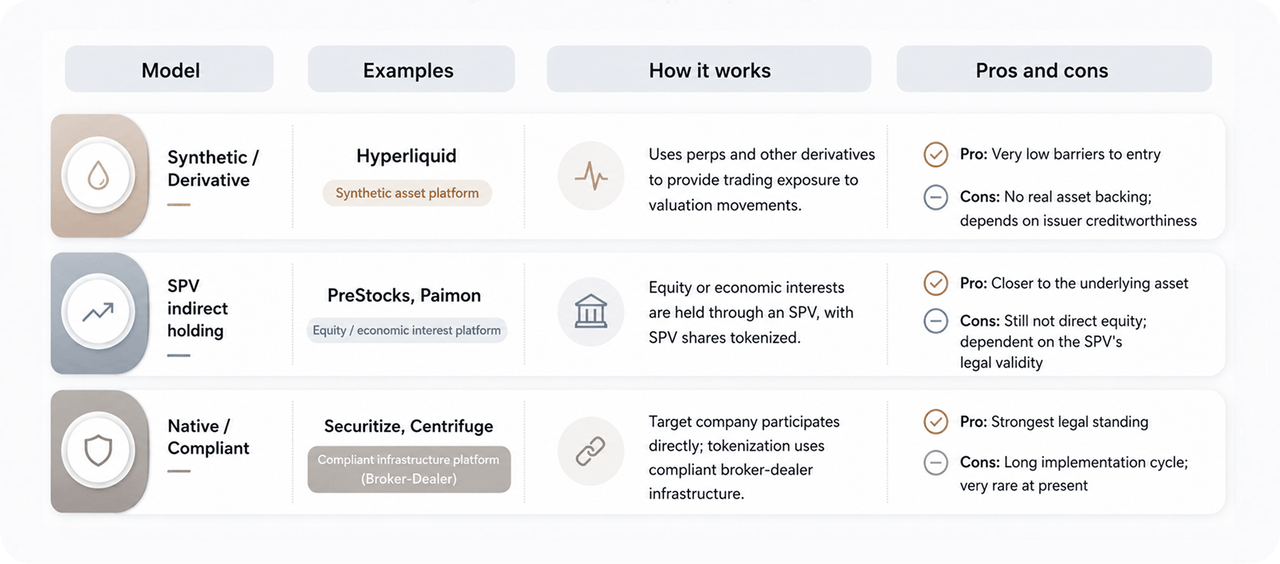
Three structural models in the market
The risk and legal profile of a Pre-IPO token depends heavily on how it's structured. Here are the three main types:
What drives token value
Pre-IPO token prices aren't a simple onchain mirror of a private company's valuation. Several factors shape pricing:
-
Underlying asset arrangement: Whether the token is backed by SPV stakes, fund interests, or other structures that indirectly track private equity. The strength of that link matters.
-
Issuer and structural credibility: Proof of underlying assets, custody arrangements, third-party audits, SPV design, legal documentation quality, and disclosure standards all affect how the market prices trust.
-
Exit and settlement path: If the target company IPOs, gets acquired, or triggers another liquidity event, whether token holders can actually realise value – through cash distributions, buybacks, or other mechanisms – is a core question.
-
Market expectations and secondary liquidity: Even without a direct equity link, markets price in growth expectations, structural complexity, liquidity discounts, and sentiment. Token prices can and do diverge from private market valuations.
A new door, with risks attached
Pre-IPO tokens have opened a new pathway to private company exposure that was previously out of reach for most investors. But the compliance risks, legal limitations, and issuer credit risks are just as real as the opportunity. The more clearly you understand the structure you're buying into, the better positioned you'll be to decide whether it fits your risk profile.
Disclaimer: This article is for informational purposes only and does not constitute investment, legal, tax, or financial advice. Pre-IPO tokens, SPV interests, synthetic assets, and other structured products may carry significant risks, including market volatility, insufficient liquidity, issuer credit risk, underlying asset uncertainty, legal structure risk, transfer restrictions, regulatory changes, and exit mechanism uncertainty. Always understand the product structure and applicable legal environment, and consider your own risk tolerance before participating.
About Bitget Wallet
Bitget Wallet is an everyday finance app designed to make crypto simple, secure, and usable in daily life. Serving over 90 million users worldwide, it offers an all-in-one self-custodial platform to send, spend,
save and
invest crypto. The app is powered by Onchain Payments Matrix, a coordination infrastructure connecting global financial rails to enable stablecoin payments at scale and programmable settlement for AI-driven transactions. Users can access
crypto cards, QR payments, bank transfers, on- and off-ramps, and an in-app marketplace to spend digital assets across online and offline merchants. Backed by a $700 million
user protection fund, Bitget Wallet supports faster, borderless onchain finance while ensuring users retain full control of their assets and private keys.
For more information, visit: X | LinkedIn | Telegram | YouTube | TikTok | Facebook | Instagram For media inquiries, contact [email protected]
For more information, visit: X | LinkedIn | Telegram | YouTube | TikTok | Facebook | Instagram For media inquiries, contact [email protected]
 2026-05-13
 Trade Stocks Onchain and Earn Rewards Around The Clock
Recommended